HomeAll Newsbenelog GmbH & Co.KG

Die EU-DPP-Normen sind da. Die Bausteine zur Umsetzung auch.

The EU DPP standards are here. So are the building blocks for implementation.

benelog GmbH & Co. KG
|
June 24, 2026
|
benelog GmbH & Co.KG
GS1 Digital Link
Digital product passport

Die EU hat den technischen Rahmen für den Digitalen Produktpass in mehreren Normen festgelegt, von der Identifikation über Datenträger, Datenaustausch, API und Datenmodell bis zu Speicherung, Zugriff und Vertrauen. Für Unternehmen und Lösungsanbieter stellt sich damit die Frage, womit sich diese Anforderungen umsetzen lassen.

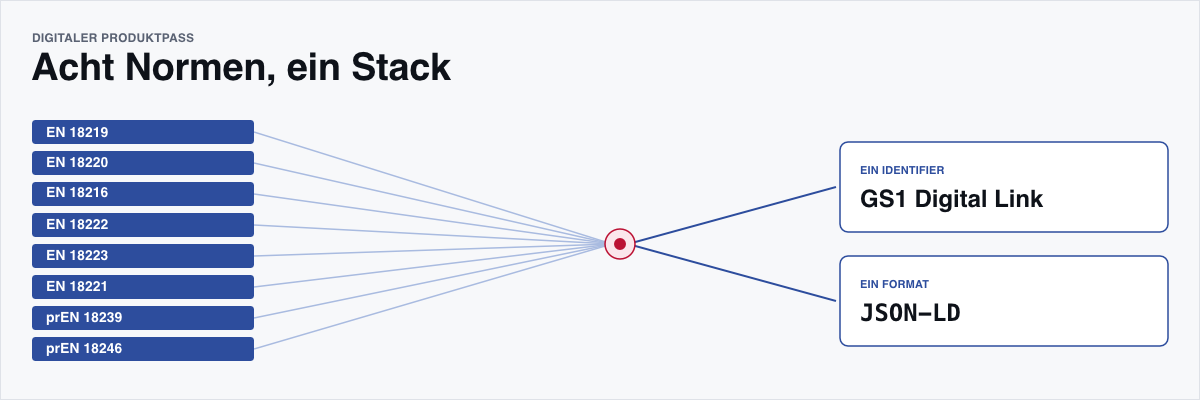
Die Antwort ist erfreulich unkompliziert: Die Bausteine liegen bereit und sind in Produktion erprobt. Die acht Normschichten greifen alle auf dasselbe zu, einen Identifier und ein Format. OpenEPCIS bedient sie mit einem zusammenhängenden Stack aus etablierten Standards:

·      GS1 Digital Link als Identifier (EN 18219)

·      QR-Code und Data Matrix als Datenträger (EN 18220)

·      EPCIS 2.0 über REST und JSON-LD für den Datenaustausch (EN 18216)

·      ein Adapter auf EPCIS 2.0 Capture und Query für die API (EN 18222)

·      EPCIS JSON-LD, CBV und GS1 Web Vocabulary für das Datenmodell (EN 18223)

·      das append-only Event-Log für die Speicherung (EN 18221)

·      Rollen und Rechte für den Zugriff (prEN 18239)

·      W3C Verifiable Credentials für das Vertrauen (prEN 18246)

Wer auf diesen Standards umsetzt, erfüllt die Normen nicht durch Zusatzaufwand, sondern durch die Architektur selbst. Mehr dazu steht in unseren FAQ unter »Wie deckt OpenEPCIS die EU-DPP-Normen ab«.


The EU has established the technical framework for the Digital Product Passport in several standards, covering everything from identification to data carriers, data exchange, APIs, and data models, all the way to storage, access, and trust. This raises the question for companies and solution providers of how these requirements can be implemented.

The answer is pleasingly straightforward: The building blocks are already in place and have been tested in production. The eight standard layers all access the same thing: an identifier and a format. OpenEPCIS supports them with a coherent stack of established standards:

Those who implement these standards comply with them not through additional effort, but through the architecture itself. For more information, see our FAQ under “How does OpenEPCIS cover the EU DPP standards?”

Further information is available here:
To the website
Translate manually?
Generate automatic translation?

Die EU hat den technischen Rahmen für den Digitalen Produktpass in mehreren Normen festgelegt, von der Identifikation über Datenträger, Datenaustausch, API und Datenmodell bis zu Speicherung, Zugriff und Vertrauen. Für Unternehmen und Lösungsanbieter stellt sich damit die Frage, womit sich diese Anforderungen umsetzen lassen.

Die Antwort ist erfreulich unkompliziert: Die Bausteine liegen bereit und sind in Produktion erprobt. Die acht Normschichten greifen alle auf dasselbe zu, einen Identifier und ein Format. OpenEPCIS bedient sie mit einem zusammenhängenden Stack aus etablierten Standards:

·      GS1 Digital Link als Identifier (EN 18219)

·      QR-Code und Data Matrix als Datenträger (EN 18220)

·      EPCIS 2.0 über REST und JSON-LD für den Datenaustausch (EN 18216)

·      ein Adapter auf EPCIS 2.0 Capture und Query für die API (EN 18222)

·      EPCIS JSON-LD, CBV und GS1 Web Vocabulary für das Datenmodell (EN 18223)

·      das append-only Event-Log für die Speicherung (EN 18221)

·      Rollen und Rechte für den Zugriff (prEN 18239)

·      W3C Verifiable Credentials für das Vertrauen (prEN 18246)

Wer auf diesen Standards umsetzt, erfüllt die Normen nicht durch Zusatzaufwand, sondern durch die Architektur selbst. Mehr dazu steht in unseren FAQ unter »Wie deckt OpenEPCIS die EU-DPP-Normen ab«.


Translate manually?

The EU has established the technical framework for the Digital Product Passport in several standards, covering everything from identification to data carriers, data exchange, APIs, and data models, all the way to storage, access, and trust. This raises the question for companies and solution providers of how these requirements can be implemented.

The answer is pleasingly straightforward: The building blocks are already in place and have been tested in production. The eight standard layers all access the same thing: an identifier and a format. OpenEPCIS supports them with a coherent stack of established standards:

Those who implement these standards comply with them not through additional effort, but through the architecture itself. For more information, see our FAQ under “How does OpenEPCIS cover the EU DPP standards?”

Generate automatic translation?
The image is too large. Please upload an image with maximum 2400 x 2400 pixels and 3 MB. You can find the recommended dimensions on the ? symbol.
uploading
fileuploaded.jpg
Upload failed. Max size for files is 10 MB.
Current:
June 24, 2026
Update News
Successful! You will be redirected immediately...
Error: Your submission could not be processed due to our automatic spam detection. We sincerely apologize and would ask you to contact us via the chat at the bottom right so that we can correct this error.