HomeSoftware overviewData Graphs
Software
–
Data Graphs

Data Graphs - Plattform für Digitale Produktpässe (DPP)

Data Graphs - Platform for Digital Product Passports (DPP)

GS1 Digital Link
DPP

Data Graphs – Plattform für Digitale Produktpässe (DPP)

Eine umfassende Lösung für den gesamten DPP-Lebenszyklus – von der Erstellung bis zur Veröffentlichung – für unterschiedliche Produktbranchen.

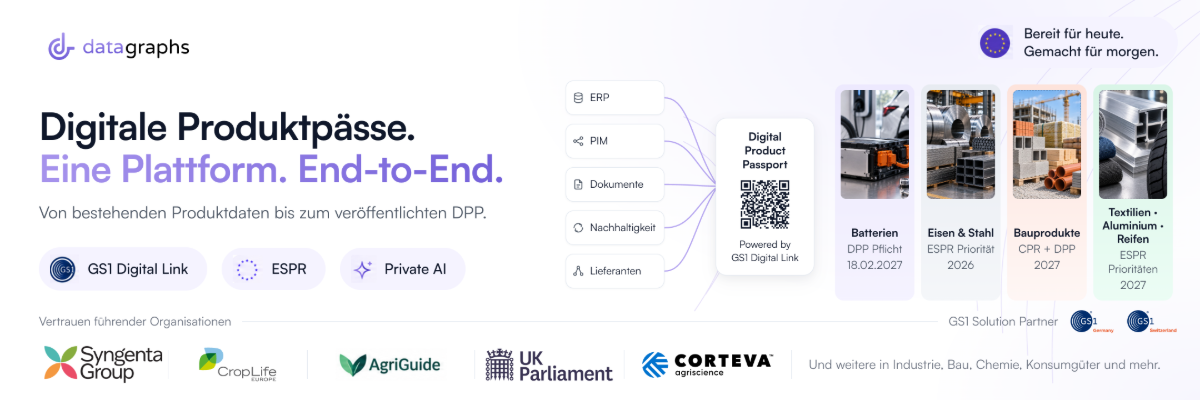
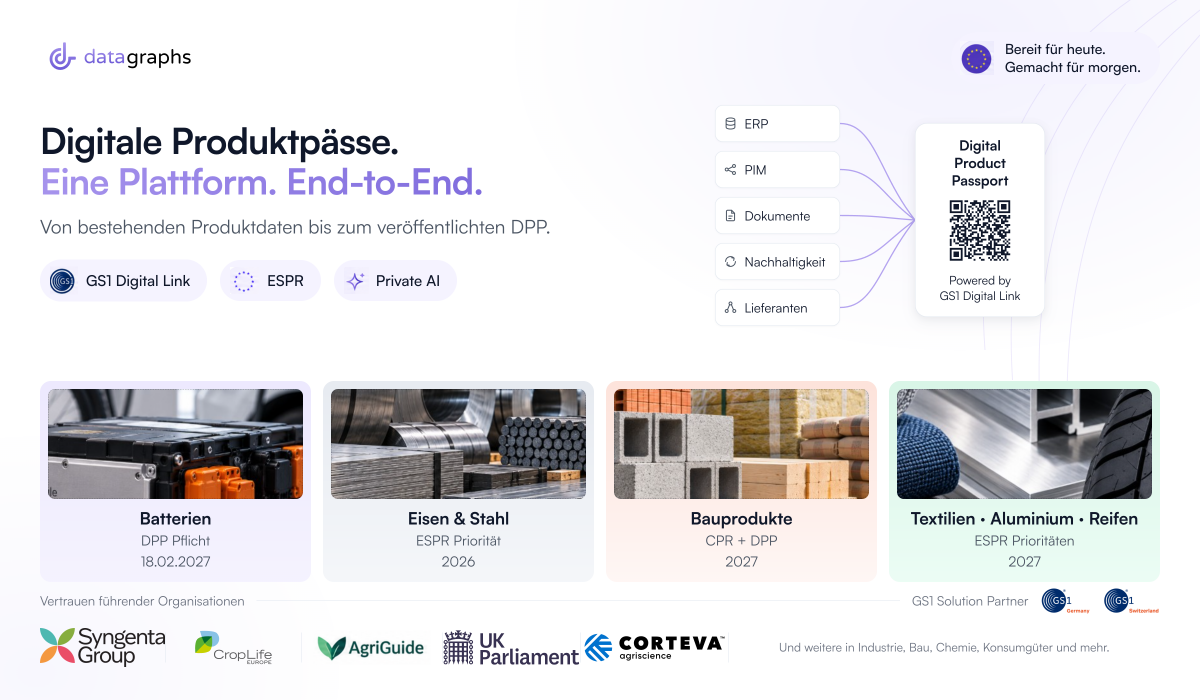
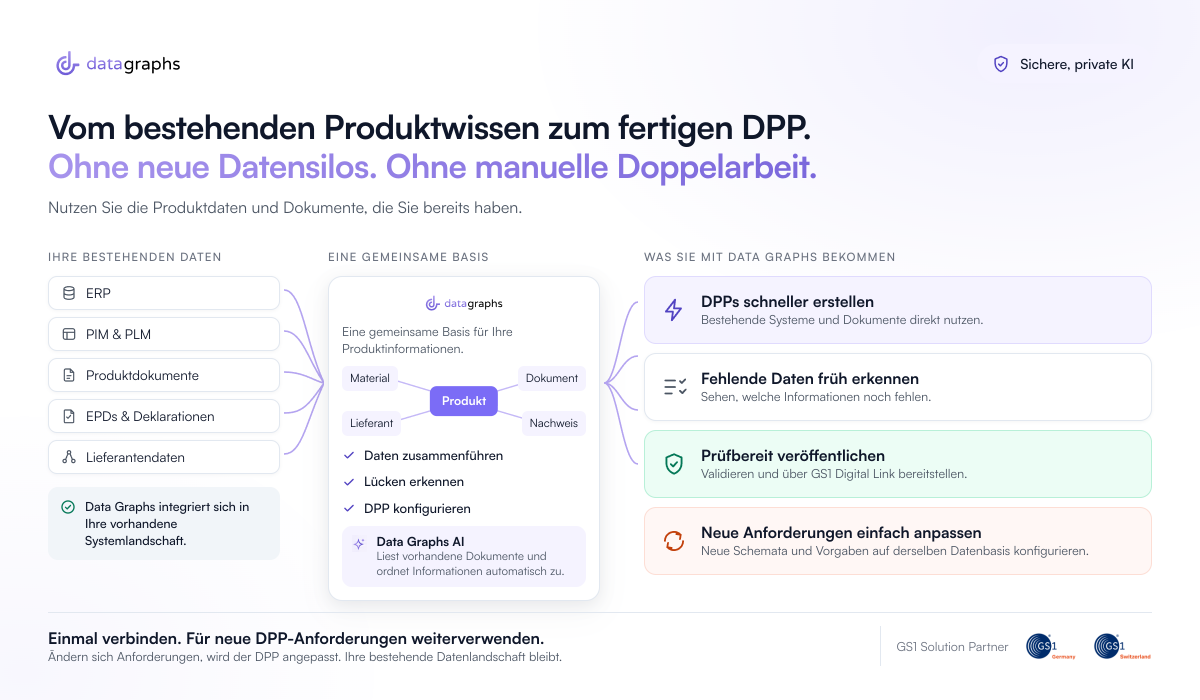
Data Graphs ist eine Plattform für Digitale Produktpässe (Digital Product Passports, DPP), die bestehende Produktdaten aus unterschiedlichen Systemen und Dokumenten verbindet, strukturiert und für regulatorische und branchenspezifische DPP-Anforderungen nutzbar macht. Unternehmen können Digitale Produktpässe auf Basis ihrer bestehenden Datenlandschaft erstellen, verwalten und veröffentlichen, ohne für den Digitalen Produktpass ein neues Datensilo aufbauen zu müssen. Die Plattform unterstützt Unternehmen bei der Umsetzung neuer DPP-Anforderungen im Rahmen der EU-Ökodesign-Verordnung (ESPR).

Bestehende Produktdaten aus ERP, PLM, PIM und MDM nutzen

Data Graphs verbindet Produktinformationen aus ERP-, PLM-, PIM- und MDM-Systemen über APIs. Zusätzlich können Informationen aus Spezifikationsblättern, EPDs, Deklarationen, Prüfberichten und Lieferantendokumenten verarbeitet und mit bestehenden Produktdaten verknüpft werden.

Unterschiedliche DPP-Anforderungen flexibel konfigurieren

Data Graphs strukturiert Produktinformationen in einem gemeinsamen, vernetzten Datenmodell. Auf dieser Grundlage lassen sich unterschiedliche Produktschemas und DPP-Sichten konfigurieren. Ändern sich regulatorische Anforderungen, Datenfelder oder branchenspezifische Vorgaben für den Digitalen Produktpass, können diese angepasst werden, ohne die zugrunde liegenden Produktinformationen als separates Datenprojekt neu aufbauen zu müssen.

Data Graphs kann für unterschiedliche Produktgruppen und DPP-Anforderungen eingesetzt werden, darunter Batterien, Bauprodukte und alle weiteren Produktbereiche, die vom Digitalen Produktpass betroffen sind.

Unstrukturierte Produktinformationen mit Data Graphs AI verarbeiten

Data Graphs AI kann relevante Informationen aus Spezifikationsblättern, Deklarationen, Prüfberichten und anderen unstrukturierten Dokumenten extrahieren, einem Produktschema zuordnen und fehlende Informationen identifizieren. Dadurch können bestehende Dokumente und Lieferantendaten direkt für die Erstellung und Pflege Digitaler Produktpässe genutzt werden.

DPPs in Minuten ohne Programmierung konfigurieren

Mit Data Graphs können Nutzer mithilfe natürlicher Sprache mit ihren Produktdaten arbeiten und Digitale Produktpässe konfigurieren. Datenmodelle, Produktschemas und DPP-Sichten lassen sich in wenigen Minuten erstellen und anpassen, ohne Programmierung oder technische Expertise.

Unternehmensdaten mit Private AI schützen

Produkt- und Unternehmensdaten bleiben geschützt und werden nicht an öffentliche Large Language Models (LLMs) übermittelt. Data Graphs ermöglicht den Einsatz von KI auf Unternehmensdaten, ohne sensible Produktinformationen mit öffentlichen KI-Diensten zu teilen.

Digitale Produktpässe mit GS1 Digital Link und Discovery Services bereitstellen

Data Graphs stellt Digitale Produktpässe sowohl nutzerfreundlich als auch maschinenlesbar bereit. Die GS1-Integration ist optional. Wo dies sinnvoll ist, können GS1-Identifikatoren wie die GTIN und kompatible 2D-Codes genutzt und Digitale Produktpässe über GS1 Digital Link mit den entsprechenden GS1 Register- und Discovery Services verknüpft werden.

Damit können digitale Systeme auf Basis einer Produktidentifikation die zugehörigen DPP-Informationen und Dienste auffinden und auflösen. Data Graphs stellt die zugrunde liegende DPP-Daten-, Hosting- und Publishing-Infrastruktur unabhängig von der GS1-Integration bereit.

DPP-Software für den produktiven Einsatz

Data Graphs wird bereits produktiv für digitale Produktinformationen in allen 27 EU-Mitgliedstaaten eingesetzt. Data Graphs unterstützt unter anderem Syngenta Group, CropLife Europe, Corteva und AgriGuide.

Data Graphs ist Solution Partner von GS1 Germany und GS1 Switzerland.

Mehr über Data Graphs und unsere Lösung für Digitale Produktpässe erfahren

https://datagraphs.com/solutions/digital-product-passports

Data Graphs – Platform for Digital Product Passports (DPP)

A comprehensive solution for the entire DPP lifecycle—from creation to publication—for various product industries.

Data Graphs is a platform for Digital Product Passports (DPP) that connects and structures existing product data from various systems and documents, making it usable for regulatory and industry-specific DPP requirements. Companies can create, manage, and publish Digital Product Passports based on their existing data infrastructure without having to build a new data silo for the Digital Product Passport. The platform supports companies in implementing new DPP requirements under the EU Ecodesign Regulation (ESPR).

Leverage existing product data from ERP, PLM, PIM, and MDM

Data Graphs integrates product information from ERP, PLM, PIM, and MDM systems via APIs. In addition, information from specification sheets, EPDs, declarations, test reports, and supplier documents can be processed and linked to existing product data.

Flexibly configure different DPP requirements

Data Graphs organizes product information into a unified, interconnected data model. Based on this, different product schemas and DPP views can be configured. If regulatory requirements, data fields, or industry-specific guidelines for the Digital Product Passport change, these can be adjusted without having to rebuild the underlying product information as a separate data project.

Processing Unstructured Product Information with Data Graphs AI

Data Graphs AI can extract relevant information from specification sheets, declarations, test reports, and other unstructured documents, map it to a product schema, and identify missing information. This allows existing documents and supplier data to be used directly for creating and maintaining digital product passports.

Configure DPPs in Minutes Without Programming

With Data Graphs, users can work with their product data and configure Digital Product Passports using natural language. Data models, product schemas, and DPP views can be created and customized in just a few minutes, without any programming or technical expertise.

Product and company data remain protected and are not transmitted to public large language models (LLMs). Data Graphs enables the use of AI on company data without sharing sensitive product information with public AI services.

Provide Digital Product Passports Using GS1 Digital Link and Discovery Services

Data Graphs provides digital product passports in both user-friendly and machine-readable formats. GS1 integration is optional. Where appropriate, GS1 identifiers such as the GTIN and compatible 2D codes can be used, and Digital Product Passports can be linked to the corresponding GS1 Registry and Discovery Services via GS1 Digital Link.

This enables digital systems to locate and resolve the corresponding DPP information and services based on a product identifier. Data Graphs provides the underlying DPP data, hosting, and publishing infrastructure independently of GS1 integration.

DPP Software for Production Use

Data Graphs is already being used in production for digital product information across all 27 EU member states. Among others, Data Graphs supports the Syngenta Group, CropLife Europe, Corteva, and AgriGuide.

Data Graphs is a Solution Partner of GS1 Germany and GS1 Switzerland.

Learn more about Data Graphs and our solution for digital product passports
‍Gallery

More about

Data Graphs - Platform for Digital Product Passports (DPP)

For more information on
Data Graphs - Platform for Digital Product Passports (DPP)
you are welcome to contact us free of charge and without obligation at
Donna
Esfandiary
from
Data Graphs
record.
Donna
Esfandiary
Chief Revenue Officer

Willkommen auf dem Profil von Data Graphs! Bei Fragen zu unseren Leistungen und Angeboten stehe ich gerne zur Verfügung.

Welcome to the Data Graphs profile! If you have any questions about our services and offerings, please feel free to contact me.

1. Basic Information

Translate manually?
Generate automatic translation?

Data Graphs – Plattform für Digitale Produktpässe (DPP)

Eine umfassende Lösung für den gesamten DPP-Lebenszyklus – von der Erstellung bis zur Veröffentlichung – für unterschiedliche Produktbranchen.

Data Graphs ist eine Plattform für Digitale Produktpässe (Digital Product Passports, DPP), die bestehende Produktdaten aus unterschiedlichen Systemen und Dokumenten verbindet, strukturiert und für regulatorische und branchenspezifische DPP-Anforderungen nutzbar macht. Unternehmen können Digitale Produktpässe auf Basis ihrer bestehenden Datenlandschaft erstellen, verwalten und veröffentlichen, ohne für den Digitalen Produktpass ein neues Datensilo aufbauen zu müssen. Die Plattform unterstützt Unternehmen bei der Umsetzung neuer DPP-Anforderungen im Rahmen der EU-Ökodesign-Verordnung (ESPR).

Bestehende Produktdaten aus ERP, PLM, PIM und MDM nutzen

Data Graphs verbindet Produktinformationen aus ERP-, PLM-, PIM- und MDM-Systemen über APIs. Zusätzlich können Informationen aus Spezifikationsblättern, EPDs, Deklarationen, Prüfberichten und Lieferantendokumenten verarbeitet und mit bestehenden Produktdaten verknüpft werden.

Unterschiedliche DPP-Anforderungen flexibel konfigurieren

Data Graphs strukturiert Produktinformationen in einem gemeinsamen, vernetzten Datenmodell. Auf dieser Grundlage lassen sich unterschiedliche Produktschemas und DPP-Sichten konfigurieren. Ändern sich regulatorische Anforderungen, Datenfelder oder branchenspezifische Vorgaben für den Digitalen Produktpass, können diese angepasst werden, ohne die zugrunde liegenden Produktinformationen als separates Datenprojekt neu aufbauen zu müssen.

Data Graphs kann für unterschiedliche Produktgruppen und DPP-Anforderungen eingesetzt werden, darunter Batterien, Bauprodukte und alle weiteren Produktbereiche, die vom Digitalen Produktpass betroffen sind.

Unstrukturierte Produktinformationen mit Data Graphs AI verarbeiten

Data Graphs AI kann relevante Informationen aus Spezifikationsblättern, Deklarationen, Prüfberichten und anderen unstrukturierten Dokumenten extrahieren, einem Produktschema zuordnen und fehlende Informationen identifizieren. Dadurch können bestehende Dokumente und Lieferantendaten direkt für die Erstellung und Pflege Digitaler Produktpässe genutzt werden.

DPPs in Minuten ohne Programmierung konfigurieren

Mit Data Graphs können Nutzer mithilfe natürlicher Sprache mit ihren Produktdaten arbeiten und Digitale Produktpässe konfigurieren. Datenmodelle, Produktschemas und DPP-Sichten lassen sich in wenigen Minuten erstellen und anpassen, ohne Programmierung oder technische Expertise.

Unternehmensdaten mit Private AI schützen

Produkt- und Unternehmensdaten bleiben geschützt und werden nicht an öffentliche Large Language Models (LLMs) übermittelt. Data Graphs ermöglicht den Einsatz von KI auf Unternehmensdaten, ohne sensible Produktinformationen mit öffentlichen KI-Diensten zu teilen.

Digitale Produktpässe mit GS1 Digital Link und Discovery Services bereitstellen

Data Graphs stellt Digitale Produktpässe sowohl nutzerfreundlich als auch maschinenlesbar bereit. Die GS1-Integration ist optional. Wo dies sinnvoll ist, können GS1-Identifikatoren wie die GTIN und kompatible 2D-Codes genutzt und Digitale Produktpässe über GS1 Digital Link mit den entsprechenden GS1 Register- und Discovery Services verknüpft werden.

Damit können digitale Systeme auf Basis einer Produktidentifikation die zugehörigen DPP-Informationen und Dienste auffinden und auflösen. Data Graphs stellt die zugrunde liegende DPP-Daten-, Hosting- und Publishing-Infrastruktur unabhängig von der GS1-Integration bereit.

DPP-Software für den produktiven Einsatz

Data Graphs wird bereits produktiv für digitale Produktinformationen in allen 27 EU-Mitgliedstaaten eingesetzt. Data Graphs unterstützt unter anderem Syngenta Group, CropLife Europe, Corteva und AgriGuide.

Data Graphs ist Solution Partner von GS1 Germany und GS1 Switzerland.

Mehr über Data Graphs und unsere Lösung für Digitale Produktpässe erfahren

https://datagraphs.com/solutions/digital-product-passports

Translate manually?

Data Graphs – Platform for Digital Product Passports (DPP)

A comprehensive solution for the entire DPP lifecycle—from creation to publication—for various product industries.

Data Graphs is a platform for Digital Product Passports (DPP) that connects and structures existing product data from various systems and documents, making it usable for regulatory and industry-specific DPP requirements. Companies can create, manage, and publish Digital Product Passports based on their existing data infrastructure without having to build a new data silo for the Digital Product Passport. The platform supports companies in implementing new DPP requirements under the EU Ecodesign Regulation (ESPR).

Leverage existing product data from ERP, PLM, PIM, and MDM

Data Graphs integrates product information from ERP, PLM, PIM, and MDM systems via APIs. In addition, information from specification sheets, EPDs, declarations, test reports, and supplier documents can be processed and linked to existing product data.

Flexibly configure different DPP requirements

Data Graphs organizes product information into a unified, interconnected data model. Based on this, different product schemas and DPP views can be configured. If regulatory requirements, data fields, or industry-specific guidelines for the Digital Product Passport change, these can be adjusted without having to rebuild the underlying product information as a separate data project.

Processing Unstructured Product Information with Data Graphs AI

Data Graphs AI can extract relevant information from specification sheets, declarations, test reports, and other unstructured documents, map it to a product schema, and identify missing information. This allows existing documents and supplier data to be used directly for creating and maintaining digital product passports.

Configure DPPs in Minutes Without Programming

With Data Graphs, users can work with their product data and configure Digital Product Passports using natural language. Data models, product schemas, and DPP views can be created and customized in just a few minutes, without any programming or technical expertise.

Product and company data remain protected and are not transmitted to public large language models (LLMs). Data Graphs enables the use of AI on company data without sharing sensitive product information with public AI services.

Provide Digital Product Passports Using GS1 Digital Link and Discovery Services

Data Graphs provides digital product passports in both user-friendly and machine-readable formats. GS1 integration is optional. Where appropriate, GS1 identifiers such as the GTIN and compatible 2D codes can be used, and Digital Product Passports can be linked to the corresponding GS1 Registry and Discovery Services via GS1 Digital Link.

This enables digital systems to locate and resolve the corresponding DPP information and services based on a product identifier. Data Graphs provides the underlying DPP data, hosting, and publishing infrastructure independently of GS1 integration.

DPP Software for Production Use

Data Graphs is already being used in production for digital product information across all 27 EU member states. Among others, Data Graphs supports the Syngenta Group, CropLife Europe, Corteva, and AgriGuide.

Data Graphs is a Solution Partner of GS1 Germany and GS1 Switzerland.

Learn more about Data Graphs and our solution for digital product passports
Generate automatic translation?

2. Quick Facts

Select category(ies)
Select industry(ies)
Select language(s)

3. Media

The image is too large. Please upload an image with maximum 2400 x 2400 pixels and 3 MB. You can find the recommended dimensions on the ? symbol.
uploading
fileuploaded.jpg
Upload failed. Max size for files is 10 MB.

4. External Link

Update software
This is some text inside of a div block.
Successful! You will be redirected immediately...
Error: Your submission could not be processed due to our automatic spam detection. We sincerely apologize and would ask you to contact us via the chat at the bottom right so that we can correct this error.